By Grace Chinn, breathwork facilitator and Yoga Nidra teacher
If you’re anything like me, Yoga Nidra is a practice that finds you at exactly the time you need it most. For me, it was a lifesaver when I was a sleep-deprived mum of two who desperately needed to take the edge off the bone tiredness and make it to the end of the day.
Yoga Nidra is a guided meditation that can be best described as yogic sleep – and yes, it’s every bit as lovely and relaxing as it sounds. You do it lying down, and it takes you into a state that hovers between sleep and wakefulness – deeply relaxed, but still aware. All you need to do is get comfy, ideally in your own bed, and let yourself be guided by your teacher’s voice. If you’re intrigued, read on for the basics of this ancient yogic practice and why it holds so much potential for us in our modern world.
Want to try it tonight? Practise Yoga Nidra with me for free on my YouTube channel.
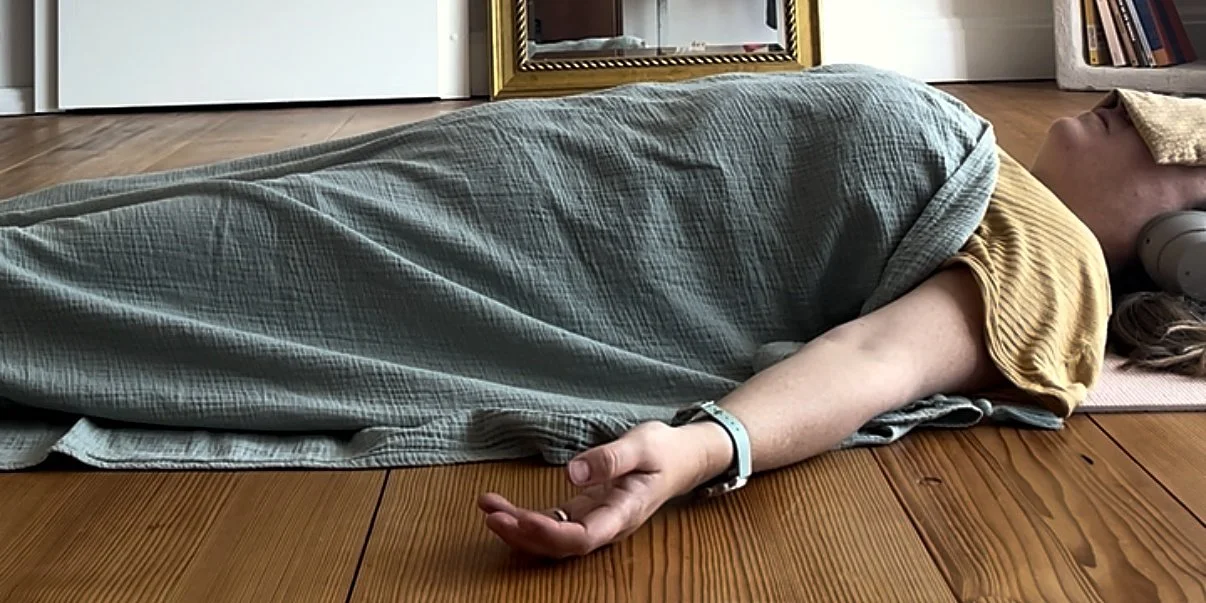
Woman lying under a blanket with an eye pillow, practising Yoga Nidra at home
So, what exactly is Yoga Nidra?
Yoga Nidra is a type of guided meditation rooted in ancient yogic practices. It’s both a practice and a state.
The state of Yoga Nidra is a unique state of consciousness somewhere between being asleep and being awake: deeply relaxed but also totally aware. We naturally pass through this state every night as we fall asleep.
The practice of Yoga Nidra is a multi-stage guided meditation that leads you into that state, so you can spend time there and tap into its benefits. It’s known for being incredibly restorative and healing.
How does Yoga Nidra work?
Yoga Nidra is a passive practice that you do lying down in shavasana (on your back, arms by your sides, totally relaxed). This helps you really let go of any tension you’re holding and fully relax into the practice. A Yoga Nidra teacher (like me!) then guides you into the state of Yoga Nidra with their voice, sometimes with gentle music in the background.
The type of Yoga Nidra I teach (I trained with the incredible Ally Boothroyd) takes around 30 minutes or more and has 11 stages, from initial relaxation, through stages such as breath awareness, a body scan, and visualisation, before a gentle reawakening at the end. Each stage helps you draw your awareness further inwards while you stay relaxed but aware.
What’s happening in your body and brain during Yoga Nidra?
As you’re guided through the stages, you sink ever more deeply into a state of relaxation as your parasympathetic nervous system (the rest and digest response) switches on. You feel it in your body and your mind: your heart rate, breathing and thoughts slow down and your muscles relax.
As part of this relaxation process, your brain waves tend to slow down too. First you move out of beta, the busy “doing” state most of us adults live in, into alpha, a relaxed, meditative state. As you drop into the state of Yoga Nidra, they slow further into theta, a state associated with intuition and creativity. In one well-known study, researchers scanned people’s brains during Yoga Nidra and found that theta activity rose alongside a big increase in dopamine, the brain’s feel-good, motivation chemical.
What’s so cool about being in a theta state?
You know that moment just before you fall asleep, when you’re dancing between being awake and being asleep and vivid thoughts, images and memories float up? That’s theta. The way I see it, there are two reasons it’s such a great state to hang out in (which is exactly what Yoga Nidra helps you do).
First, this is a deeply restorative state – there are even unproven claims from yogic tradition that 30 minutes of Yoga Nidra is equivalent to three to four hours of sleep. Whether that’s true remains to be seen, but I can share what it shifted for me. I got into Yoga Nidra when my second daughter was a baby and I was seriously sleep deprived. Her naps weren’t long enough for me to have a proper sleep, so I did a Nidra nap instead, and it really took the edge off.
Second, according to the yogis, theta is a subconscious state where our intuition and creativity come online. In Yoga Nidra, we use this state to plant what’s known as a sankalpa, so that inner change can lead to outer change.
What’s a sankalpa?
The way I understand and use it, sankalpa is the yogic term for intention. It’s a key part of a full Yoga Nidra practice and deserves its own blog post, but here are the basics, as you’ll hear it mentioned in just about any Yoga Nidra class or track online.
A sankalpa is a tool to help you move towards something, or call something into your life. I like to think of it as your “heart’s desire” or “heart’s wish” – it’s what you most yearn for in life, not in a material sense, but in terms of the texture of how life feels and who you are in it. It’s a simple, positive phrase in the present tense, such as “I am calm and at ease”.
In a Yoga Nidra practice, your teacher will guide you to choose a sankalpa that speaks to you, or offer you one. You feel into it at the start of the practice, noticing the sensations that come up when you bring it to mind and body.
Later, once you’re in the state of Yoga Nidra, you’re guided to plant the seed of your sankalpa. This is a state where the mind is receptive and you can connect to your subconscious, which the yogis believe lets you reprogramme thought patterns and beliefs. Over time, your sankalpa can shift how you think, feel and experience life.
What are the benefits of Yoga Nidra?
There’s a growing body of research into the benefits of Yoga Nidra (e.g. a study into the effects of Yoga Nidra on stress, anxiety, and depression: and an integrate review of the uses of yoga nidra), alongside plenty of anecdotal evidence. It’s been studied for issues as wide-ranging as chronic pain, migraines, stress, sleep problems, and depression and anxiety. But that’s not all: it’s also a wonderful self-development tool, helping you do the inner work that shifts how you experience life, inside and out. Here are some of the main benefits of a regular Yoga Nidra practice.
Yoga Nidra for sleep
Perhaps the best-known benefit of Yoga Nidra is better sleep. Tonnes of people use it to fall asleep, either at bedtime or when they wake in the middle of the night with racing thoughts. Researchers believe it works because it activates the parasympathetic nervous system (the rest and digest state), getting the body and mind calm enough to fall and stay asleep.
Struggling to switch off at night? In my Monthly Reset programme, I guide you through Yoga Nidra and breathwork 1:1, tailored to what’s going on for you. Find out more.
Yoga Nidra for anxiety
Yoga Nidra is brilliant for calming a racing mind. The body scan (known as rotation of consciousness) gently and intentionally brings your focus back to your body, which turns down the volume on anxious thoughts and anchors you in the present moment rather than leaving you stuck in thought loops.
Yoga Nidra for stress
Yoga Nidra helps you shift out of the stress response and into the parasympathetic branch of your nervous system– the rest, digest and repair response. In the moment, this eases feelings of stress. Over time, it can train your body to lean more naturally towards that relaxed state.
Yoga Nidra for inner wisdom
Because theta is known as an intuitive state, spending time there helps you nurture your connection with your inner wisdom. You might get a sense of knowing what you need or what to do, with no logical reasoning attached. This can be transformative – for want of a better word – once you get used to listening to what comes up and acting on it. (If inner wisdom is your thing, you’ll love my post on why connecting to your inner wisdom is the biggest life hack).
Yoga Nidra for personal development
Working with a sankalpa means that, over time, you can reprogramme your thoughts and beliefs so that your inner world and your outer experience of life line up. This won’t happen in one session, or even a few weeks – it’s a gradual process of working with the same sankalpa over time and aligning your actions with your inner wisdom.
Yoga Nidra at work and at events
Yoga Nidra is one of the easiest practices to bring to groups who are new to this kind of thing. Everyone lies down, nobody has to get anything “right”, and even the sceptics tend to get up looking like they’ve been on holiday. It’s a lovely way to help a team recover from a busy season, or to close a conference day or retreat.
Can you fall asleep during Yoga Nidra?
Oh my goodness, yes! I’ve done it many times. And that’s okay! Because you’re dancing on the edge of a sleep-like state, it’s very easy to drop off during or straight after a practice. In fact, lots of people use Yoga Nidra to help them fall asleep or get back to sleep at night. If you fall asleep, it’s not a problem – it’s just what you needed in that moment.
Small tip: if you’re doing a Nidra nap mid-afternoon and have a work call or the school pick-up coming up, set an alarm in case you drop off.
What does Yoga Nidra feel like?
We’re all different, so everyone experiences it differently, but I can share what it’s like for me and the people I’ve practised with. It’s deeply relaxing – like floating on fluffy clouds, stress melts away, tension releases. The best way I can describe it is pressing the reset button on your energy and your mind (which is why I love it mid-afternoon), or turning yourself off and on again like a computer. After a Nidra nap, I often feel like I went “somewhere” for a few seconds or minutes, and I come back refreshed and clear-headed.
Is Yoga Nidra the same as NSDR?
NSDR stands for non-sleep deep rest, a term coined by neuroscientist Dr Andrew Huberman to describe practices that bring you into deep relaxation without falling fully asleep. So Yoga Nidra is one type of NSDR, and the practice that NSDR scripts borrow from most.
Where can you practise Yoga Nidra?
You can practise Yoga Nidra in person or online. While you can go to a yoga studio that offers it, I’ll be completely honest with you: I think online is ideal. You can do it in your own bed, in your own space – no need to go anywhere else. And if you do it in the evening, you can drift straight off to sleep afterwards. Again: ideal. No fancy props needed – aside from a bolster under your knees if you like, though a cushion or pillow works too. You just need your bed, sofa or a yoga mat, a blanket, a cushion and maybe an eye mask. Headphones make it even more immersive.
Ready to give Yoga Nidra a go?
Want to try it for free? Head to my YouTube channel and practise with me tonight. Watch now
Want it tailored to you? I guide Yoga Nidra 1:1 as part of my Monthly Reset programme. Find out about the Monthly Reset
Planning a team day, retreat or event? Get in touch
Hosting a podcast or writing about rest, sleep or burnout? I’d love to chat. Get in touch
Enjoy!
Grace Chinn is a breathwork facilitator, trainer and Yoga Nidra teacher based near Lausanne, Switzerland. She trains new facilitators through a 400-hour breathwork apprenticeship, works 1:1 with women online and in person, and brings breathwork to retreats, conferences and team days, pitched at just the right level of woo for the room.